Showing posts with label Kronotsky-reserve. Show all posts

Thursday, March 28, 2013

Red fox wedding.


Right around this time of year the foxes have their mating season in Kronotsky Nature Reserve in Kamchatka. Several times I was fortunate to be a "wedding' photographer for a fox couple. And during my shift in 2010-2011 I was waiting for my neighbor, Cosmo (Кузя in Russian) to play with his mate, Cosimina. But a new female fox appeared and their relationship was complicated and hidden from an outsider, such as me. Whenever I saw Cosmo, he pretended to be very bored, yawning and chasing fleas. He seemingly avoided his partners. Eventually a new fox, who I called Alisa, and Cosmo did have several cubs, four of which were raised, I have told about them in the summer of 2011 in this blog.


Today I will show you a marriage of another couple from the River Tikhaya (meaning quite in Russian) in Kronotsky Nature Reserve. I was a wedding photographer for them in spring of 2008.


This is a groom, Lizovin.


And this beautiful lady is a bride, Liza.


Walking together.


A female fox often starts a chase, this way she is probably testing the health of the future father of her cubs. The pregnancy lasts for around 50 days, and the little foxes are born in may in deep burrows and stay there for the first month of their life. That year Liza and Lizovin raised 5 cubs.


A love triangle happened in Liza and Lizovin life as well. One day another female fox appeared and has taken Lizovin away for a day. But Liza was very wise, and she greeted Lizovin with happiness when he came back.

Below, you can find one of the photos from this story at high resolution, that you can use for desktop backgournds. I call that photo foxtrot on river banks.

Monday, March 11, 2013

Banks of the Geysernaya River, Kamchatka


Nowadays, while working on a new book about Kamchatka I often look through my photo archives. And I often think about how lucky I was to have a chance to work in the Valley of Geysers for several seasons in the past. It is a miraculous place. And the river in the middle of it, called Geysernaya (derived from word Geyser in Russian), is also miraculous. It is only 12 km long (7.5 miles) - but so much diversity exists along it.


On picture above, a famous volcanologists, V.A. Drozdin, who has worked in this area for many years, is crossing a river.

Sunday, March 10, 2013

In the Uzon volcanic caldera.


Kronotsky Nature Reserve. Lake Dalnee (Дальнее - Distant in Russian) is a maar lake in Uzon Volcano Kaldera.


Saturday, February 23, 2013

Superior mirage?


Sometimes Kamchatka air becomes very clear and it is possible to see very far. Several times I have seen these distant mountains at the very edge of the horizon as if they appear behind the Pacific ocean. This photo is taken with a powerful 500mm lens. I am still not sure what did I photograph...

Abandoned settlement "Kronoki".


In winter.


And in fall.

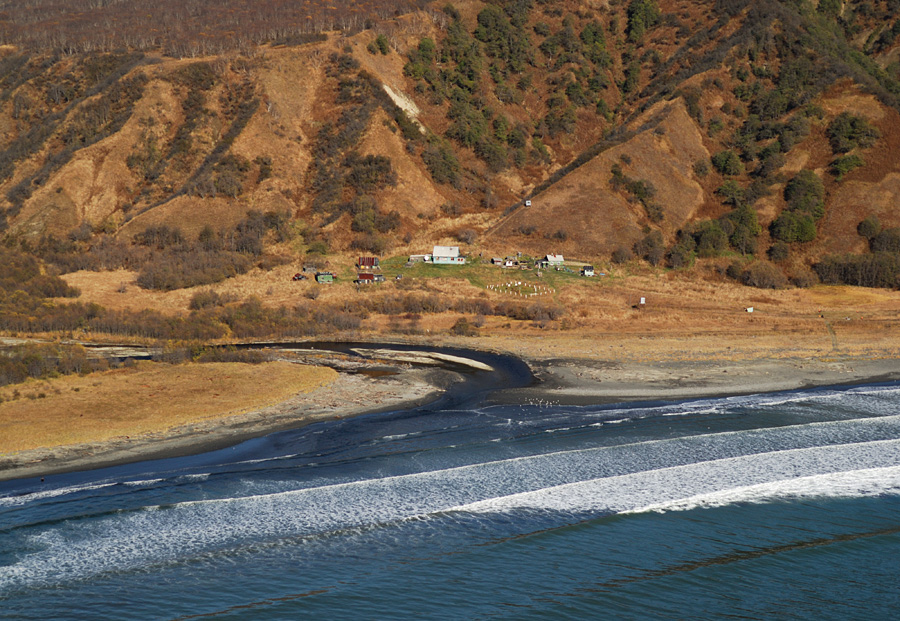
In the middle of last century this town was very busy. There was seismological base here, military base, Kronotsky Nature reserve station. Many expeditions have started from here. The buildings have extended for a mile and a half along the coast line. Nowadays only ranger and weather station are active, the rest is abandoned. The Nature reigns here, and humans are only present to observe.


Tuesday, February 12, 2013

Cosmo from Kronotsky Nature Reserve.


I was looking through my archives in search of photos for my new photo-book and came across these photos of Cosmo (Кузя in Russian) from 2007. At that time he was much younger and playful than when I last saw him, during my wintering in Kronotsky Nature Reserve in 2010-2011. This is one of the stories from that period: http://wildlife-photo-russia.blogspot.com/2011/06/it-may-be-really-bad-for-my-health.html


Wednesday, February 6, 2013

Mr. Fox and his reflection.


This is one of my fox-neighbors running along the banks of Kronotskaya River in Kronotsky Nature Reserve in Kamchatka. I took this photo during my long wintering in a remote ranger station there in 2010-2011.


The Kronotskaya river very rarely freezes at winter due being spring fed. This a photo taken by my middle son, Petr couple of weeks before the photo above.


Animals remember the summer salmon runs in this river, and keep frequently checking for fish...


But there is no fish here at this time of year!

Originally posted at:

Лис с зеркальным отражением http://shpilenok.livejournal.com/64680.html

Еще одна Кроноцкая тайна: http://shpilenok.livejournal.com/58939.html

Завтра - апрель! http://shpilenok.livejournal.com/58770.html

"Здесь рыбы нет!" http://shpilenok.livejournal.com/64680.html

Saturday, January 26, 2013

Rock climbing bears.


What would make this large male bear pretend to be an avid rock climber to climb up as these slippery rocks? This takes place in the middle of May in the Valley of the Geysers in Kronotsky Nature Reserve in Kamchatka. At this time of year the rest of Kamchatka is still covered with thick snow. These rocks are warmed by volcanic warmth, and covered with first lush grass. That grass must be very tasty for bears after they spent half a year with no food in their winter dens.

In the Valley of the Geysers bears graze on the river banks of the Geysernaya river as well as on the edges of the geysers. Geysers are hot, so in this area, despite all the precautions, people get injured almost every year. Do bears also burn their paws in hot geysers?


It is funny to watch how young and inexperienced animals behave around the geysers. They look like tourists who are left without a guide. When they first see eruption of geysers they get scared and try to run away burning their paws in hot. And only later they learn to carefully try the ground underneath before putting all weight on it.


Experienced animals find use of park wooden paths in the places where the land is especially hot...


...and use stones when crossing the hot springs.


And this bear has made the best prescription for his chemical burn injury: he submerged himself in the Geyser River for couple of hours. The cool waters cooled down the burn and washed away the chemicals. So the bear survived. As a matter of fact, there are no recorded deaths of bears due to chemical and temperature burns. As opposed to humans who did have lethal incidents...


Read more about my observations how bears avoid injuries at one of my previous posts (this link will take you to google-translation of the original story).