Thursday, March 28, 2013

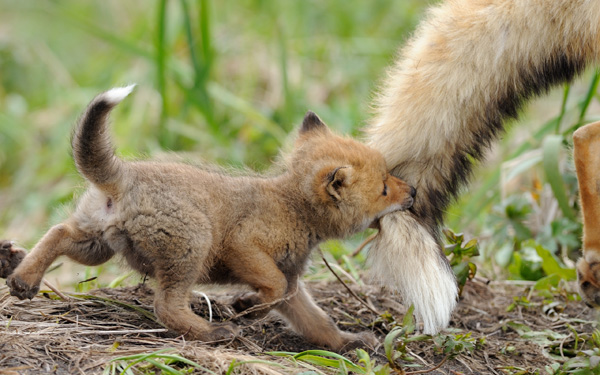
Red fox wedding.


Right around this time of year the foxes have their mating season in Kronotsky Nature Reserve in Kamchatka. Several times I was fortunate to be a "wedding' photographer for a fox couple. And during my shift in 2010-2011 I was waiting for my neighbor, Cosmo (Кузя in Russian) to play with his mate, Cosimina. But a new female fox appeared and their relationship was complicated and hidden from an outsider, such as me. Whenever I saw Cosmo, he pretended to be very bored, yawning and chasing fleas. He seemingly avoided his partners. Eventually a new fox, who I called Alisa, and Cosmo did have several cubs, four of which were raised, I have told about them in the summer of 2011 in this blog.


Today I will show you a marriage of another couple from the River Tikhaya (meaning quite in Russian) in Kronotsky Nature Reserve. I was a wedding photographer for them in spring of 2008.


This is a groom, Lizovin.


And this beautiful lady is a bride, Liza.


Walking together.


A female fox often starts a chase, this way she is probably testing the health of the future father of her cubs. The pregnancy lasts for around 50 days, and the little foxes are born in may in deep burrows and stay there for the first month of their life. That year Liza and Lizovin raised 5 cubs.


A love triangle happened in Liza and Lizovin life as well. One day another female fox appeared and has taken Lizovin away for a day. But Liza was very wise, and she greeted Lizovin with happiness when he came back.

Below, you can find one of the photos from this story at high resolution, that you can use for desktop backgournds. I call that photo foxtrot on river banks.

Tuesday, March 19, 2013

New expedition plans.


Many old photographers, including myself, remember the days of film photography with warmth. It seems like at that time I used to have more time to actually photograph then now, when I spend lots of time in front of computer screen... The winter has passed, it is almost time to depart for a new expedition, but nearly half of my last year's archive are still not processed:(

On a good side, I have almost finished a new book about photographer's life in Kamchatka.
The photo above is from a folder "Kenozero - 2012".


Past Sunday I participated in a program "Otkryvashka" (Открывашка in Russian, meaning a little discovery) on Echo of Moscow radio station. This is a program for children and youth, and our subject was "Discovering Kamchatka".

You are welcome to watch it online and read the record via google translator at this link. I have announced my plans to fulfil one of my dreams, to travel to Kamchatka from my home in Bryansk forest by land. For this adventure I plan to use a military type vehicle. I plan to to take a year for the trip one way, stopping in different Russian nature reserves and national parks, telling my readers about Russian wildlife and history of nature conservation. If everything works out as planned, after reaching Kamchatka, I will spend a year there, traveling across it and recording everything. And then, hopefully, I will take another year to return back on a different, northern route.

The picture above is taken in May, when the spring just emerges in Kamchatka.

Originally posted at following
http://shpilenok.livejournal.com/174547.html
http://shpilenok.livejournal.com/175979.html
http://shpilenok.livejournal.com/173998.html

Monday, March 11, 2013

Banks of the Geysernaya River, Kamchatka


Nowadays, while working on a new book about Kamchatka I often look through my photo archives. And I often think about how lucky I was to have a chance to work in the Valley of Geysers for several seasons in the past. It is a miraculous place. And the river in the middle of it, called Geysernaya (derived from word Geyser in Russian), is also miraculous. It is only 12 km long (7.5 miles) - but so much diversity exists along it.


On picture above, a famous volcanologists, V.A. Drozdin, who has worked in this area for many years, is crossing a river.

Sunday, March 10, 2013

In the Uzon volcanic caldera.


Kronotsky Nature Reserve. Lake Dalnee (Дальнее - Distant in Russian) is a maar lake in Uzon Volcano Kaldera.


Saturday, March 2, 2013

Collection of desktop backgrounds.


 I will always remember one episode with young group of tourists from Japan in Kamchatka. When these students arrived to Kurile lake in South Kamchatka Sanctuary one girl took out her cell phone and discovered that there is no reception. She showed the phone to other students and something very interesting started... They all were so excited, jumping around and hugging each other - they were happy that there are still places in our planet without cellular coverage and that they were fortunate to visit a place like that. 

According to Japanese students, I am a very happy person. And it is true. Since university graduation I did not live in a city for over a week. Most of my life I am spending out in the nature with only radio reception in the past, and satellite reception now. Even my house here, in the buffer zone of Bryansk Forest Nature reserve does not have a stable land line or cell phone reception. Sometimes, in good weather I do get cell phone signal on the roof of my house. But the signal is too week for 4G internet. Therefore I have been using quite expensive sattelite internet to publish posts in this blog. It is not unlimited, I had to pay for every bit of data send or received, for each comment posted. Over the time, internet became my largest expense...

But recently, one nice company have offered to sponsor my internet. РАДУГА-ИНТЕРНЕТ (Rainbow-Internet in Russian) is specializes on providing affordable sattelite internet across Russia. Their specialist visited my village and installed the equipment and now my internet is the fastest it has ever been.

The good news for my readers are that now, I finally can start a project that I could not afford before. I will start to upload high-resolution images for my readers to use on their computer desktops. Below there are several ones that my readers already requested, but I will continue and you will see more. 

If there are some images that you particularly like and would like to see in high-resolution - you are welcome to leave a comment to this or any other posts. Thanks again to РАДУГА-ИНТЕРНЕТ!


CLICK READ MORE BELOW for hi-resolution 2560х1600 images of the photos above suitable for desktop background.  Thanks again to my sponsor РАДУГА-ИНТЕРНЕТ.

Enjoy and contact me via shpilenok@mail.ru if you want to obtain a high quality print of any of them or other photos published here, at shpilenok.livejournal.com or at my photo-site shpilenok.com.

Another view of Kronotsky Volcano.


Friday, March 1, 2013

First day of spring in Bryansk Forest!


These are some of black-eared residents of Bryansk Forest Nature reserve. It is the first day of spring here, and the snow is slowly melting. Very soon white storks will come and the spring will fully bloom.
 
 
Originally posted at:
and

Wednesday, February 27, 2013

Mefodiy 16 months ago and now.


On a first photo Mefodiy is less than a day old. He recieved this name from my readers. Mefodiy was the first bison being born free in a newly reintroduced european bison population in Bryans Forest Nature Reserve.  
 
This morning, before the sunrise, I took a photo of him at the additional food supply location in the reserve. During two hours while I was observing him, Mefodiy managed to butt with all the grown up bulls, just as before.
 
Additionally, he tried to lift up the haystack weighting 300 kilograms (661 pounds). But he couldn't. He is not quite strong enough to lift it... yet!
 
 
Originally posted in Russian/Оригинал на русском:

Tuesday, February 26, 2013

In my village, Chuhrai...

 
Many years ago, when I first settled in an abandoned forest ranger station in Bryansk Forest I bought a horse, Gazik. At that time he was my only transport in a land of swamps and forests. I was riding it almost every day throughout the year, on sleigh in winter.
 
After I moved to my current house on the other side of the Nerussa River in a small village Chuhrai, the accessibility to my home did not improve a whole lot. You could only get there on a tractor or a military type off-road vehicle, and not the all year around, just when it was dry. So the horses were still the most reliable transport. 
 
These are my current horses on the photo above. On the right is my favorite horse, Aza. When she was young, she was grey with dark spots, but now she appears to be all white. Aza is 26 years old, amazing horse. She feels responsibility for a rider. This is my only horse that I have never fallen from and she has never fallen under me either. All my children has learned to ride with Aza, and the youngest ones has ridden on it before they could walk. Aza and I has caught a lot of poachers in Bryans Forest Nature Reserve in the past, even those on motorized vehicles.
 
The black horses to the right are my wife’s horses. The one in the middle is Orlik; he grew up in a half-wild herd, and after I bought him, he would frequently run away, back to his brothers and sisters. Later on, Orlik and Aza had a daughter, Zorka. She is to the right on this picture, all black with a white spot on her forehead. A very stubborn horse… But after she was born, Orlik realized that this is his home and never escaped again.
 
Now the life is very different. Almost any car can drive though a forest road that leads to my village. Therefore the horses are not being used so often. Moreover I got “infected” with Kamchatka “virus” and I am often far from my home on lengthy expeditions. It is a pity that I cannot take my horses with me to Kamchatka, they would be so much more useful there… Instead, they are just living as in retirement over here, in my village. And I am thinking, as I am preparing for my new expedition, how to organize their safe and comfort life when I am away…
 
 
And this a view from my window, I just took this picture. Wild boar is chasing my beloved dog. She first tried to chase him away from the property, but he is stronger. The boar is interested in grains that I leave on the ground for birds; at first he was only coming at night, but today he showed up in the middle of the day. Maybe I should organize photo-safary tours to photograph this abundant wildlife in my backyard?
 
 
And this is Nika, my best present in 2012. My wife and I took her from animal shelter last year and she immediately became a best game buddy to my children and best friend to all other members of the family, including the goat and roster that I told you about in this post: http://wildlife-photo-russia.blogspot.com/2012/12/here-in-bryansk-forest.html

We do not know who was Nika's previous owner, but her behavior indicates that she could have been a rescue dog. She is obviously guarding my children when they swim and tries to pull them to the shore whenever they start splashing or diving on the water.


Saturday, February 23, 2013

Superior mirage?


Sometimes Kamchatka air becomes very clear and it is possible to see very far. Several times I have seen these distant mountains at the very edge of the horizon as if they appear behind the Pacific ocean. This photo is taken with a powerful 500mm lens. I am still not sure what did I photograph...

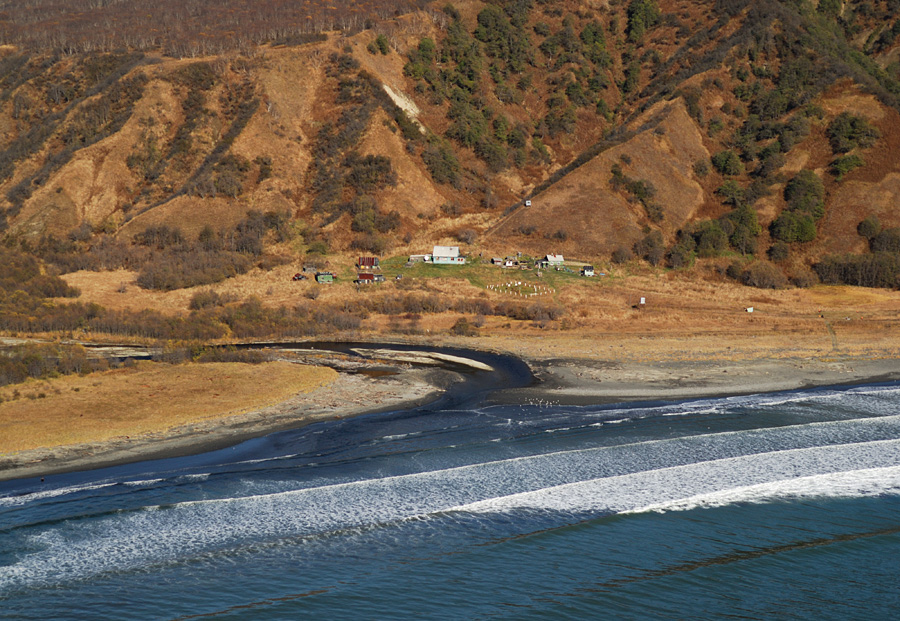
Abandoned settlement "Kronoki".


In winter.


And in fall.

In the middle of last century this town was very busy. There was seismological base here, military base, Kronotsky Nature reserve station. Many expeditions have started from here. The buildings have extended for a mile and a half along the coast line. Nowadays only ranger and weather station are active, the rest is abandoned. The Nature reigns here, and humans are only present to observe.